
Genesis 45: 1-5
Joseph could stand it no longer. There were many people in the room, and he said to his attendants, “Out, all of you!” So he was alone with his brothers when he told them who he was. 2 Then he broke down and wept. He wept so loudly the Egyptians could hear him, and word of it quickly carried to Pharaoh’s palace. 3 “I am Joseph!” he said to his brothers. “Is my father still alive?” But his brothers were speechless! They were stunned to realize that Joseph was standing there in front of them. 4 4 “Please, come closer,” he said to them. So they came closer. And he said again, “I am Joseph, your brother, whom you sold into slavery in Egypt. 5 But don’t be upset, and don’t be angry with yourselves for selling me to this place. It was God who sent me here ahead of you to preserve your lives.
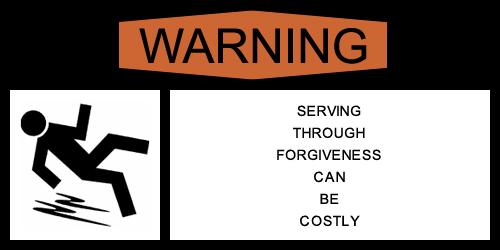
Now we come to what I believe to be the hardest area to serve others through and that is forgiveness. This is why Jesus came, to serve, “For even the Son of Man did not come to be served, but to serve, and to give his life as a ransom for many.” Mark 10:45. As sinners we need forgiveness and in giving His life for us Jesus served us through forgiveness. Forgiveness is at the very heart of what it means to be a Christian; forgiveness is where we see both the practical and theological collide into one. But true forgiveness comes at a cost and does not just happen, it has to be pursued intentionally. God had a plan, Jesus was intentionally born into this world, he intentionally pursues us and was willing to pay the price. Jesus knew what was on the other end of pursuing forgiveness, the cross, it was ugly and painful but He intentionally chose the cross when He chose to forgive us. The question comes, are we willing to pay the price will we intentionally pursue forgiveness? Jesus, when speaking of forgiveness, uses the image of debts to describe the nature of sins Matt. 6:12 “And forgive us our debts, as we forgive our debtors” which is interesting because when someone wrongs us there is an overwhelming sense that the wrongdoer owes us, because the wrong has created a debt. When we are wronged we feel a need to make the other person pay for that debt. Often our way of making people pay is destructive, we try to hurt them externally, physically we lash out, verbally yelling at them, emotionally by make them feel bad, or internally we hope that something bad happens to them. Once they have suffered in some measurable way we feel that the debt has been paid and they are free. This sense of debt and need to pay seems impossible to escape, yet here is where the gift of forgiveness enters. Forgiveness means giving up the right to seek repayment from the one who harmed you. This goes against the nature of debt, and here is why I believe many of us refuse to forgive, because it must be recognized that the debt doesn’t just go away, it still has to be paid. If we talk about monetary debts, regardless of whether the debt is national or personal, it has to be paid. Our national debt is a little overwhelming, even if it is a great picture of our sin, so we will leave that analogy for another blog and for now we will think about a personal debt. Let’s say, in a carless moment, you throw a rock and break my window which costs $200; your careless act creates a debt of $200. If you hand over the money to replace the window, I get a new window and you’re out $200 because you paid the debt. What happens if I bring in the gift of forgiveness, does the debt disappear? No, what happens is that I absorb the cost because I pay the $200 to fix it or I deal with the bugs or rain that come into my house, one way or another I pay the price. Why don’t we like forgiveness? Because to forgive means we cancel a debt by paying it and absorbing it ourselves. The debt always has to be paid by someone; the hard truth is that forgiveness is a voluntary form of suffering. When others are sinned against, they lose something, happiness, reputation, mental stability, a relationship, a job or opportunity.
There are really only two things we can do about a sin done to us. Make them pay or forgive.
Sin always creates suffering, Joseph was thrown into a pit by his brothers, he was sold into slavery, he suffered and he had two choices, make his brothers suffer or forgive. Forgiveness is always hard because it is always costly, emotionally it can be very expensive, Joseph wept and not just a tear or two but so loudly that those who were not in the same room could hear him. When wrong is done there is a debt and forgiving others means that we will personally incur the debt in at least two ways:
- One, refuse to hurt the person directly, Joseph refused to be vengeful, he didn’t try to pay his brothers back by inflicting pain on them. Instead of bringing pain he brought peace. This is hard to do and we have to be consciously aware of the subtle ways that we try to exact payment while pretending that we aren’t. By making cutting remarks or dragging out past hurts, being harder on those who have wronged us, being more demanding or controlling, being cold by avoiding and ignoring. When we do these things we are only pretending to forgive because really we are still trying to make them pay. Joseph instead invited his brothers to come closer.
- Second, refuse to hurt them indirectly; this takes two forms, external and internal.
A.) Externally we use slander and gossip, or as we like to call it in our socially sophisticated society “spin”. Often we turn here when we can’t directly hurt others or we are the passive aggressive type. We know we should not slander and gossip so we have created several sneaky vehicles that we try to use to get around this road block. We run over those who have hurt us using the bus of pretending to warning others about them. Sometimes in our attempt to seeking sympathy and support we purposely run them over in sharing our hurt. What did Joseph do? He removed everyone else from the room and dealt directly with his brothers.
B.) Internally we like to indulge in ill-will in our hearts, we have all the wrongs on instant replay and many times they are on a continual loop playing in our minds. This only leads to a continued sense of loss where we keep the hurt fresh so we can stay actively hostile toward the person. The Internal always becomes external at some point. I don’t think that Joseph had spent the last 13years reliving his hurts playing the scenes over and over in his mind, instead he had been busy serving. Hurt in our life has the power to derail our lives and take us in destructive directions. Instead of staying in the lane that God has for us we become preoccupied with our hurt. We become the distracted driver, who instead of driving gets side tracked by playing the hurt over and over in our mind. Instead of keeping our eyes on God and the road ahead, we focus on our hurts and in our distraction we drift out of God’s lane only to swerve into oncoming traffic. Even in the inevitable head on collision and the resulting hurt we will blame that on the one who originally hurt us. The problem is that nursing our personal pain always leads to more pain. It’s easy to vilify or demonize the offende,r especially in our imagination, but what happens when I admit the common sinful humanity I share with them. Joseph didn’t vilify his brothers, instead, he forgave.
I think forgiveness is a commitment to refrain from trying to make others pay, Josephs focus was not on his personal pain and making others pay but God’s amazing grace “It was God who sent me here ahead of you to preserve your lives.” Though it is extremely difficult and painful and you are bearing the cost of the sin, your focus has to remain on God and his work in and through your life. Joseph doesn’t just recognize God’s ability to work in his life but he recognizes what God wants to do through his life when he says God’s plan was to preserve his brothers. In living out God’s plan Joseph allows the grace and mercy of God to be displayed not only to his brothers but to a waiting and watching world. For me this is the hardest part of the story, God wants to preserve, to save the ones who caused Joseph the pain. If He used Joseph to do this doesn’t He want to use me? This doesn’t seem fair but by bearing the cost of the sin, we walk in the footsteps of Jesus Colossians 3:13 “Make allowance for each other’s faults, and forgive anyone who offends you. Remember, the Lord forgave you, so you must forgive others.” Look to the cross and you see God forgiving us but you also see His suffering, the nails, thorns, sweat and blood; forgiveness costs. Why do we shy away, even refuse to Serve through forgiveness, because it’s hard, because its serving that leads to suffering and we are only comfortable with one side of that coin, the side where Jesus suffers for us. What are you going to do with the other side of the coin, the side where you serve? Just as it did in Joseph’s life, forgiveness will deepen your character and free your walk, what will you choose?
 Moments in the life of a Pastor